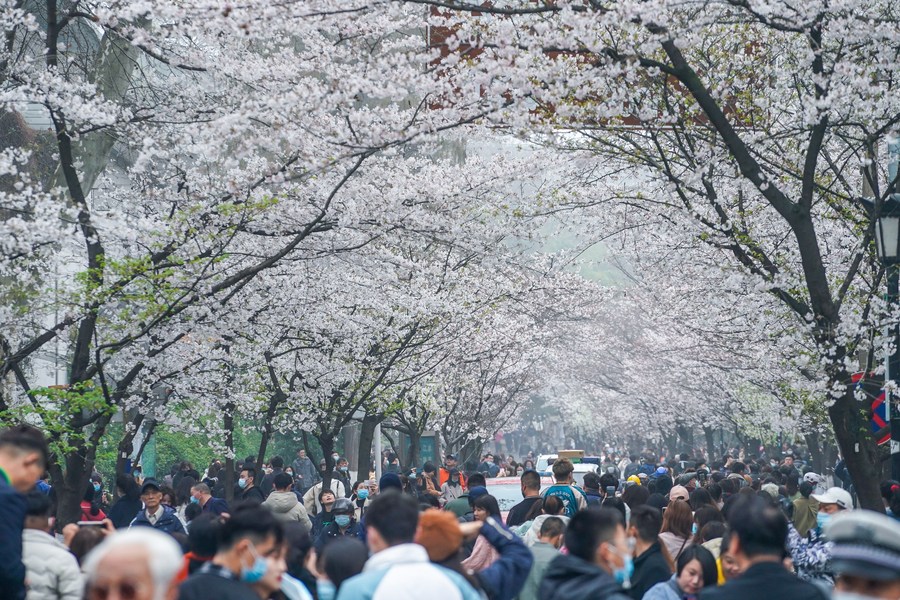
Tourists
view cherry blossoms at Jimingsi Road in Nanjing, east China's Jiangsu
Province, March 16, 2021. Cherry blossoms in Nanjing are in full bloom
recently. (Xinhua/Li Bo)
China's
tourism sector has reported a strong recovery so far this year and is
expected to continue its current momentum as China further lifts travel
restrictions amid a stable COVID-19 situation.
The
tourism sector logged encouraging statistics during the Spring Festival
holiday in mid-February, according to data from the China Tourism
Academy.
Domestic tourism revenue
recorded year-on-year growth starting from the third day of the weeklong
holiday, while the number of tourists traveling to and from major
tourist destinations like Guangdong, Shanghai and Beijing exceeded or
almost reached the levels seen during the 2019 Spring Festival.
The
demand for leisure city travel, vacations in the suburbs, family trips
and study tours showed a strong upward trend, the academy said.
The
country's civil aviation industry handled approximately 23.95 million
passenger trips in February, a jump of 187.1 percent year on year, the
latest data from the Civil Aviation Administration of China showed.
Air
travel picked up steam soon after the holiday, during which many
Chinese people opted to stay put in response to the government's call to
avoid unnecessary gatherings.
Passenger
traffic on domestic routes has returned to the level seen during the
same period in 2019, according to data from online travel service
provider qunar.com.
Increasing hotel
bookings also pointed to people's willingness to travel. Sanya, Wuxi and
Lhasa are among tourists' favored domestic destinations.
By
March 9, hotel bookings for the Tomb-sweeping Day holiday in early
April had increased to 4.5 times the number of bookings seen on the same
date a year earlier.
The number of
hotel reservations on May 1, the first day of the five-day May Day
holiday, has exceeded the number from the same day in 2019, the data
showed.
Beijing has relaxed COVID-19 restrictions as the Chinese capital has seen no new locally transmitted cases for over a month.
Those
traveling from domestic low-risk areas and arriving in Beijing are not
required to provide negative nucleic acid test results, and taxi and
online car-hailing services between Beijing and other cities will
resume.
Temperature checks will also
be unnecessary at community and village entrances, while indoor and
outdoor cultural and entertainment venues such as parks, scenic spots,
libraries, museums and theaters will be allowed to hold up to 75 percent
of their visitor capacities.
Data
showed soaring air and train ticket bookings in and out of Beijing
immediately after the announcement from the municipal government.
Industry insiders said people are using the coming holidays to make up for the trips they missed earlier.
The
costs of travel, accommodation and entrance tickets to cultural and
entertainment venues have declined significantly since the outbreak of
COVID-19, and some local governments may continue offering travel
vouchers to attract tourists, allowing people to take highly
cost-effective vacations this year, said Ma Yiliang, an analyst with the
China Tourism Academy.
According to a
report from the academy, an estimated total of 4.1 billion domestic
tourist trips will be made in China this year, up 42 percent from 2020.
Domestic
tourism revenue is expected to surge 48 percent to reach 3.3 trillion
yuan (about 507.47 billion U.S. dollars), read the report.
China's
economic growth gathered steam in the first two months of 2021, with
major economic indicators such as industrial output, retail sales and
fixed-asset investment all surging more than 30 percent, according to
data released by the National Bureau of Statistics on Monday.



 Related News