|
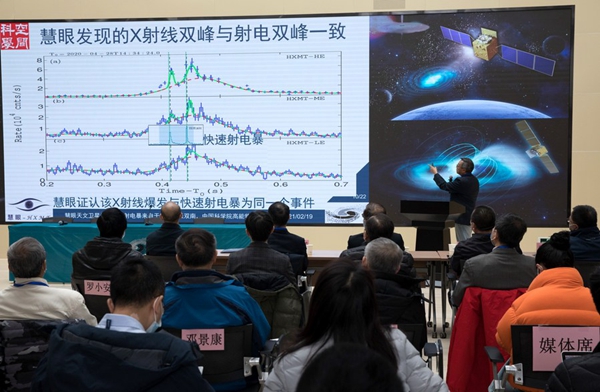
Zhang
Shuangnan, lead scientist of China's Hard X-ray Modulation Telescope
(HXMT), speaks during a press conference at the Institute of High Energy
Physics under the Chinese Academy of Sciences in Beijing, capital of
China, Feb. 19, 2021. [Photo/Xinhua] The
Chinese Academy of Sciences on Tuesday released details of the most
recent scientific achievements from its space science programs,
including space-based gravitational wave detection, space microgravity
experiments, and the observation of black-hole explosions. According
to the academy, Taiji-1, China's first satellite to conduct experiments
on key technologies related to space-based gravitational wave
detection, has completed all preset experimental tasks. It has
accomplished the highest degree of precision in space laser
interferometry so far in China. Meanwhile,
SJ-10, China's first satellite to conduct microgravity experiments, has
for the first time achieved the development of a cell embryo to a
blastocyst under microgravity conditions, revealing the key factors
affecting early embryo development of mammals in a space environment. Finally,
China's Hard X-ray Modulation Telescope, also known as Insight, clearly
observed the panoramic view of the explosion of black hole binaries for
the first time. The three satellites
were all deployed by the CAS as part of its space-science pilot
project, which was formally established in 2011. The
CAS will continue to strengthen the research in space science areas
such as the extreme universe, space-time ripples, sun-earth panorama,
and habitable planets, in order to better understand the universe, said
Wang Chi, director of the National Space Science Center under the CAS.
| 





 Related News