|
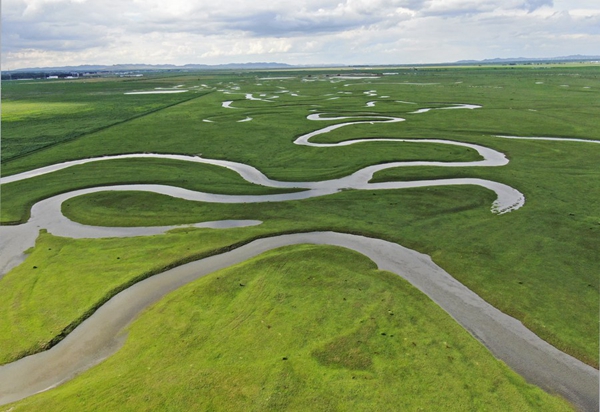 Aerial
photo taken on July 17, 2021 shows a view of the grassland in Saibei
management district of Zhangjiakou, north China's Hebei province.
[Photo/Xinhua] China
plans to plant 500 million mu (about 33.33 million hectares) of forests
and grasslands in the next five years -- 100 million mu per year -- to
help achieve its carbon emission reduction goals, according to the
country's forestry authorities. The
task includes planting 54 million mu of trees and 46 million mu of grass
each year, said Zhang Wei, head of the ecological protection and
restoration department of the National Forestry and Grassland
Administration (NFGA). The
afforestation plan is part of China's efforts to fulfill its commitment
to peaking carbon dioxide emissions by 2030 and achieve carbon
neutrality by 2060, as forests and grasslands are important carbon sinks
that absorb and store carbon dioxide from the atmosphere. China
aims to increase its forest coverage rate to 24.1 percent and its
grassland vegetation coverage to 57 percent by 2025, as outlined in the
country's 14th Five-Year Plan (2021-2025) on the protection and
development of forests and grasslands. The
country also aims to raise its forest stock volume to 19 billion cubic
meters by the end of 2025, an increase of 1.4 billion cubic meters from
last year. The carbon peak and carbon
neutrality targets are a huge opportunity for the development of
forests and grasslands, as the country eyes the expansion of forest
coverage and the improvement of forest quality to facilitate attainment
of the climate goals and contribute to global ecological security. China's
forest carbon reserves have hit 9.2 billion tonnes, with an average
annual increase of over 200 million tonnes over the past five years,
which is equivalent to a carbon sink of 700 million to 800 million
tonnes, according to NFGA data. The
country has created the world's largest planted forests, raising its
forest cover from 12 percent in the early 1980s to 23.04 percent in
2020, with its forest stock volume hitting 17.56 billion cubic meters. As
a result of sustained forest conservation and tree planting efforts, at
least 25 percent of the global foliage expansion since the early 2000s
came from China, according to a study published in the journal Nature
Sustainability in 2019. In addition
to afforestation, Zhang said work will be carried out to improve the
quality of forests and their ability to reserve carbon. He said work
will be done to protect natural resources to reduce carbon pool loss,
and forest bioenergy will be developed. Construction materials such as
steel and cement will be replaced with bamboo and timber to cut
emissions. Over the next five years,
China will also improve its measuring and monitoring of carbon sinks,
promote carbon sink trading, and explore ways to build a platform for
forest and grassland carbon sink trading, he said. In
Inner Mongolia, an important ecological barrier in north China, an
average of 600,000 hectares of land have been afforested annually over
the past five years, raising the region's forest coverage rate to 22.1
percent. Local forestry authorities
in the region's Greater Hinggan Mountains forest area have been piloting
a carbon sink trading project since 2014, allowing companies that
surpass their emission caps to purchase carbon sinks in the area to
offset excess emissions. By April
this year, the transaction volume of the carbon sink trade in the area
totaled 4.9 million yuan (about 756,114 U.S. dollars). Zhang
said that the participation of private capital in the carbon emissions
reduction campaign will be encouraged, and the government is ready to
help key regions, organizers of major events, enterprises and the public
to achieve carbon neutrality with forest and grassland carbon sinks.
| 





 Related News