Immunization plan that prioritizes large cities, port areas reasonable, expert says
Health experts have expressed confidence in narrowing the regional disparity in China's mass vaccination campaign.
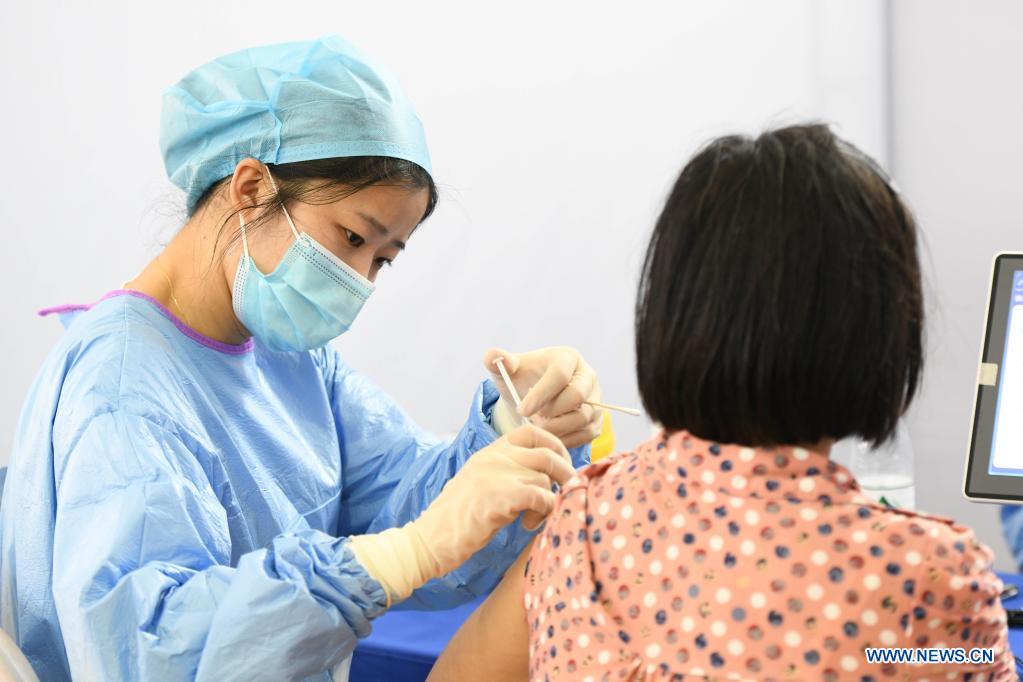
A woman receives a dose of COVID-19 vaccine at a vaccination site in
Shushan District of Hefei, East China's Anhui province, May 15, 2021.
[Photo/Xinhua]
However, they also warned that a lack of awareness in some areas
about the severity of the virus could hinder progress toward herd
immunity, which is expected to be achieved by the end of this year.
The regional gap in the country's mass vaccination campaign is a
natural outcome of its staggered immunization approach, deepened by
temporary constraints on production capacity and varying enthusiasm for
getting vaccinated, they said.
"Our immunization plan that prioritizes distribution to large cities
and port areas, as well as speeding up inoculating workers in the
healthcare and public service sectors is reasonable and feasible," said
Zeng Guang, chief epidemiologist at the Chinese Center for Disease
Control and Prevention.
Some areas are likely to fall behind at the moment due to limited
supplies, but China's step-by-step approach is well planned and will be
bolstered by expanding production later this year, he added.
Feng Duojia, chairman of the China Association for Vaccines, said
sufficient supplies are the prerequisite for speeding up immunization.
He added that China has consistently ramped up production capacity. The
recent scaling up of production has been spurred by an acceleration in
the pace of vaccinations, fresh local outbreaks and growing global
demand for domestically made products.
"The total output is expected to exceed 3 to 4 billion by the end of
this year, and is likely to approach 10 billion by the end of 2022," he
said, adding that the staggered rollout of vaccines in different regions
is a stopgap measure.
Duan Yufei, head of the Guangdong Health Commission, said the
province had classified areas under a three-tier system based on whether
they are port cities, their inoculation capacity, and the level of
population mobility and frequency of foreign exchanges. The province's
five largest cities are designated as first-tier areas for vaccination.
"When supplies are not very large, we focus on guaranteeing vaccines
in the first-tier areas. And when supplies grow, we deliver more
vaccines to areas in lower tiers," he said. "Key areas and high-risk
groups should receive vaccines first."
As of Monday, 527.25 million vaccines had been administered nationwide, according to official data.
In Beijing, over 16.3 million people, or 84 percent of its population
had received at least one shot as of Tuesday afternoon. More than 13.6
million people, or 70 percent of the population, in the capital have
been fully vaccinated.
In Shanghai, 51.4 percent of local residents had received at least one dose as of May 17.
Dalian, a port city in the northeastern province of Liaoning, said
nearly 70 percent of its permanent residents, or about 5 million people,
had been given at least one dose as of Monday. Twenty-five counties and
cities in Yunnan province, which borders Vietnam, Laos and Myanmar, had
also vaccinated 97 percent of their 4 million target group, according
to official data.
Experts said there is also now a heightened sense of urgency to get
vaccinated due to the realities of recent local and overseas COVID-19
outbreaks.
"From the raging outbreak in India to sporadic local infection
clusters, their impact on lifting the willingness of Chinese people to
get vaccinated is huge, especially in areas recently affected by the
virus," said Liang Xiaofeng, vice-president of the Chinese Preventive
Medicine Association.
Dalian and Ruili have each experienced at least two local outbreaks
in the past year. Anhui province in East China has been battling a
small-scale outbreak since May 13.
Local officials said daily inoculations broke records on May 16, with
1.18 million doses given, up 40 percent from the daily average recorded
for the previous week.
The rise in enthusiasm for inoculations has spread nationwide. "The
number of days that it took for China to administer 10 million doses has
greatly shortened," Shao Yiming, a researcher at the China CDC, said in
an interview with Xinhua News Agency.
It took just seven days to achieve the 500 million threshold from 400
million doses, data from the National Health Commission shows.
But experts said challenges to build herd immunity-with an estimated
80 to 85 percent of the total population fully inoculated-are still
strong, especially in inland regions.
In Gansu province in the northwest, only about 5 percent of the
population had received a first dose as of the middle of this month. The
rates in North China's Shanxi province and Ningxia Hui autonomous
region in the northwest were also lower than 25 percent as of mid-May,
official data shows.
"Of course, we do not hope to see sluggish paces in some regions
compared with the national average," Shao said. "We should be tense, but
there is no need to panic as vaccine supplies are sufficient and
production capacity will speed up gradually."
Zeng Guang, from the CDC, said more efforts should be made to create a sense of urgency among the public to get vaccinated.
"If a proper understanding of vaccines regarding their safety,
efficacy and urgency can be built up in wider regions, I do not think we
will even need tactics such as giving free gifts or bonuses to lure
people," he said.
Jiang Qingwu, a professor of epidemic disease research at Fudan
University's School of Public Health, said local governments can beef up
mobilization and promotion efforts.
"In the meantime, health departments should plan and coordinate vaccination work meticulously," he said in a recent interview.



 Related News