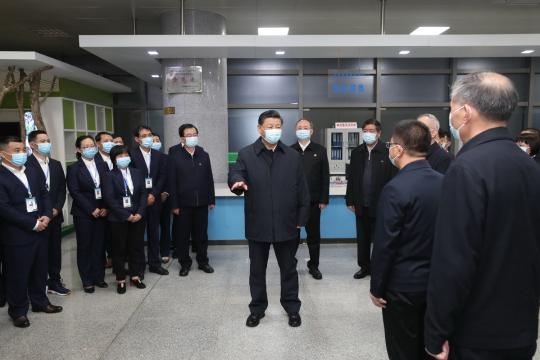
Xi Jinping,
general secretary of the Communist Party of China Central Committee,
visits a rural property rights transaction center in Shaxian district of
Sanming city, Fujian province on March 23, 2021. [Photo/Xinhua] While visiting a rural property rights transaction center in
Sanming's Shaxian district, Xi stressed respect for people's pioneering
spirit in reforms, saying the people are the real heroes. He hailed the active efforts made in the district in collective
forest tenure reform, and said Sanming is an important birthplace of
such reforms. In the past, Chinese farmers were excluded from collectively owned
forestry and shared few timber revenues. As a result, they lacked the
incentives to protect forests, and timber theft was rampant. To solve those problems, Fujian launched a reform to decentralize the
collective forest tenure system in favor of individual or household
management in 2003. The move is considered the start of China's new
round of forest tenure reform. It echoed Xi's instruction to develop
forestry as an industry while protecting the environment when he worked
in Fujian between 1985 and 2002. Local authorities have explored a number of reform measures,
including taking steps to encourage farmers to transfer their timberland
to forest cooperatives and issuing more loans to forestry businesses to
solve their financial problems. The total output value of forestry reached 114.6 billion yuan ($17.6
billion) in 2019 in Sanming. The city's forest coverage is expected to
exceed 80 percent in 2020, local authorities said. Xi told officials that for major reforms, trials should be conducted
first to gain experience before such reforms are promoted. The
methodology of "crossing the river by feeling the stones" is relevant
for institutional reforms and will continue to work, he added. Xi also went to Yubang, a village famous for Shaxian delicacies such
as pork wonton, peanut sauce noodles and over 100 other dishes, and
called on local people to turn the restaurant business into a pillar
industry to increase farmers' incomes and promote rural vitalization.
| 


 Related News