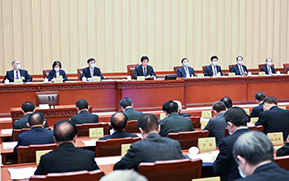
The National Committee of the Chinese People's Political Consultative
Conference, China's top political advisory body, holds a news
conference via video link on March 3, 2021, one day ahead of the opening
of its annual session. [Photo/Xinhua]
The annual session of China's top political advisory body will open
on Thursday in Beijing and last for six-and-a-half instead of the usual
10 days, a spokesman said on Wednesday.
The decision was made given the requirements of COVID-19 prevention
and control and the experience of last year's session, Guo Weimin,
spokesman for the fourth session of the 13th National Committee of the
Chinese People's Political Consultative Conference, said at a news
conference on Wednesday.
Customarily, the CPPCC National Committee starts its annual meeting
on March 3, and the National People's Congress on March 5, with each
lasting for 10 days. About 3,000 national legislators and around 2,100
national political advisers are gathering in Beijing to review work
reports of the central government and put forward suggestions on major
tasks.
The country's biggest annual political event-the two sessions-was
postponed last year from March to May as more focused efforts were
needed to fight COVID-19 at the beginning of the year.
Guo said that last year's session was held in the form of online and
offline meetings and had a shorter duration, fewer staff members and
more streamlined documents.
"It was a great success and was praised by all sectors of society," he said.
Guo said that further improvements will be made this year and the
session will be optimized to enhance its efficiency and quality, in
order to give full play to the role of plenary sessions as the highest
form of political consultation.
Further innovative measures will be introduced to ensure more practical and efficient meetings, he said.
The spokesman said that facing many challenges such as a shorter
period between last year's and this year's session and the inability to
hold many offline activities due to the pandemic, the CPPCC National
Committee intensified its consultative work.
Over the year, the CPPCC National Committee held 23 consultative
meetings, organized 80 inspection and survey tours, submitted more than
7,500 items of information to related departments and submitted about
5,900 proposals raised by its members, Guo said.
"The proposals by national political advisers were well dealt with
last year, with innovative methods and improved quality, overcoming the
impact of the pandemic," he said.
Guo said that multiparty cooperation and political consultation under
the leadership of the Communist Party of China is the basic system of
China, and it has unique strengths and distinctive features.
It can truly represent the fundamental interests of the people, unite
all political parties and people without party affiliation to work for a
common goal and pool opinions and suggestions to make decision-making
more scientific and democratic, he said.
He called on national political advisers to further fulfill their
dual responsibility of offering suggestions and building consensus to
contribute to the modernization of China's system and capacity for
governance.



 Related News