|
At
6:50 a.m., Liu Xiaochen unhurriedly boards a high-speed train for
Shanghai, traveling more than 60 km to start his day of work in the
metropolitan city in less than an hour. "The
high-speed trains are fast and on time, and I also do not need to worry
about traffic congestion," said Liu, who lives in the city of Kunshan
in Jiangsu Province that borders Shanghai. For
many people like Liu, such a daily commute is common nowadays, thanks
to the fast-paced regional integration of the Yangtze River Delta which
encompasses Shanghai and the provinces of Jiangsu, Zhejiang and Anhui. The
delta region, roughly the size of Germany, is one of China's most
economically active, open and innovative regions, contributing to about
one-fourth of the national gross domestic product. As a national
strategy, the integrated development of the delta region, also the
country's largest city cluster, has been accelerating. "The
more efficient transport connectivity in the Yangtze River Delta has
facilitated the flow of capital, talent, resources and technologies,
making it easier for joint scientific research and better allocation of
the industry chain," said Chen Wen, a researcher with the Chinese
Academy of Sciences. STRONGER CONNECTIONS Improved
connectivity within the Yangtze River Delta, like the mushrooming
high-speed railways and densely constructed expressways, has made the
358,000-square-km expanse one of the most populated and urbanized city
clusters in China. 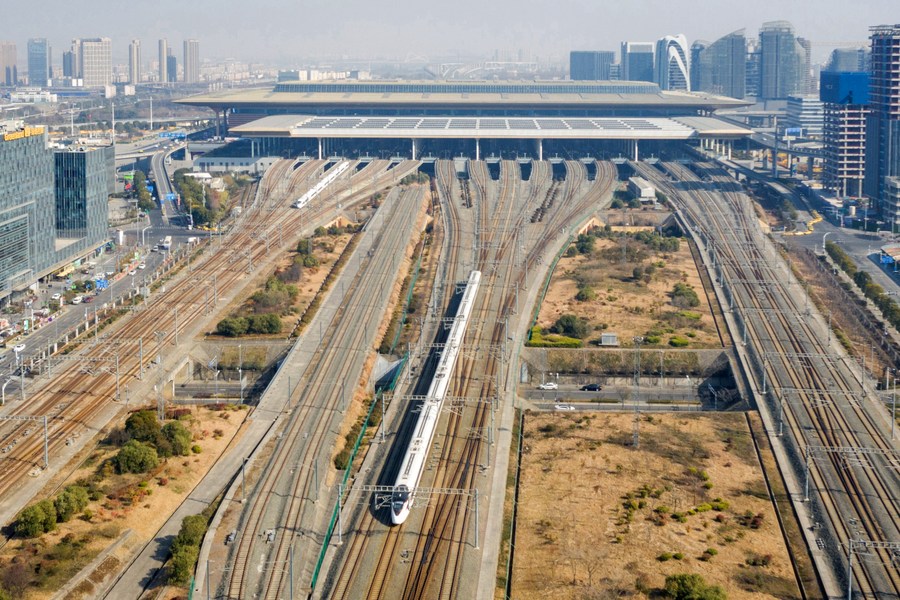
Aerial
photo taken on Jan. 19, 2021 shows a bullet train running in Nanjing,
capital of east China's Jiangsu Province. (Photo by Su Yang/Xinhua) With
the construction of 11 new railway projects kicking off this year, the
delta region is expected to have 17,000 km of rail lines in service by
2025, including 9,500 km of high-speed railway, according to the China
Railway Shanghai Group Co., Ltd. "My
wife and I live in Jiangsu's Taicang, but our daughter has settled down
in Shanghai. The absence of shortcuts used to be a nuisance for family
reunions," said Wu Qiping, a villager at Taicang's Ludu village, which
borders Shanghai's Jiading District but was split by a river. In
June 2020, a 1.8-km-long highway with a bridge was built to directly
link the village with Jiading District, shortening the travel time
between the two places from over half an hour to a minimum of three
minutes. "The
new road offers great convenience to around 7,000 villagers like Lu, as
they can visit relatives, pursue jobs and go shopping in Shanghai more
easily," said Li Ye, Party chief of Ludu village. The
convenience came after authorities in the region moved to build new
roads to link the dead-end inter-provincial highways to accelerate
regional integration. The
power networks in the region are also accelerating integration.
Construction of a 385-meter-tall power transmission tower is underway in
Jiangsu's Jiangyin City, which is part of a 500-kV power transmission
project that will cross the Yangtze River to supply clean energy to the
more developed cities of the delta region. "The
southern part of Jiangsu consumes two-thirds of the energy of the
province yet lacks power resources, but the northern part is abundant in
renewable energy resources," said Wang Weiyuan, a staff worker from
State Grid's Jiangsu branch. 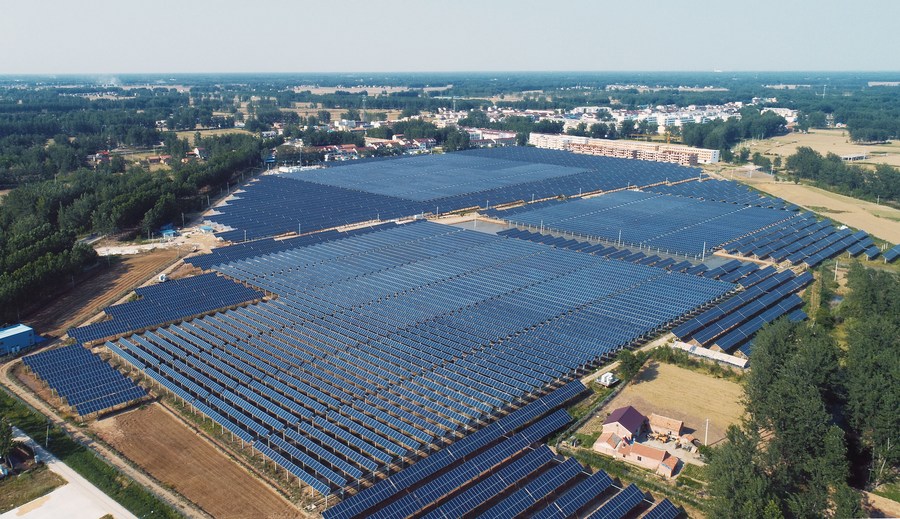
Aerial
photo taken on June 23, 2018 shows the Xinyuan photovoltaic (PV) power
station built on the top of agricultural greenhouses in Tangji Township
of Lianshui County, east China's Jiangsu Province. (Xinhua/Li Yuze) "The
project will help better connect the power networks in the Yangtze
River Delta region, helping achieve energy sharing among cities and
effectively promoting power integration in the region," Wang added. INDUSTRIAL SYNERGY At
the national-level pilot zone of Internet of Vehicles (IoV) in
Jiangsu's Wuxi City, scenes of self-adjusted traffic lights to reduce
congestion and unmanned car parking are giving a glimpse of the future
smart traffic industry. As
a highland of the Internet of Things (IoT) industry in China, Wuxi is
home to more than 3,000 IoT companies, and the city is working with its
neighbors throughout the industrial chain. "IoV
is an emerging industry, injecting new impetus to the high-quality
development of the Yangtze River Delta, and the regional integration
also provides it huge opportunities," said Zhen Hongbo, general manager
of Shennan (Wuxi) Internet of Vehicles Co., Ltd. 
Unmanned
catering cars park outside the subway station of Zhangjiang Jinke Road
in Shanghai, east China, Nov. 26, 2020. (Xinhua/Fang Zhe) "Most
of our partners are in the Yangtze River Delta, and closer connections
can help improve the industrial chain as well as the industry's
technical standards," Zhen added. In
recent years, the Yangtze River Delta has been the pacesetter in many
cutting-edge industries. The localities have joined hands to promote the
development of the digital economy, as more than 180,000 5G base
stations have been built to support innovation projects. At
a high-level forum on the region's integrated development held in Wuxi
on Thursday, authorities launched four regional industry chain alliances
for the sectors of integrated circuit, biomedicine, new energy vehicles
(NEVs) and artificial intelligence. The
Yangtze River Delta Biomedical Industry Chain Alliance was based in the
city of Suzhou, Jiangsu, focusing on integrating the resources of
enterprises, public platforms, universities and research institutions to
promote the delta region into an innovation base for the biomedical
industry. The
region, home to the factories of Tesla and NIO, is an important
production base for NEVs. In the first quarter of this year, the output
of NEVs in Shanghai and Anhui skyrocketed by 380 percent and 358 percent
year on year, respectively. 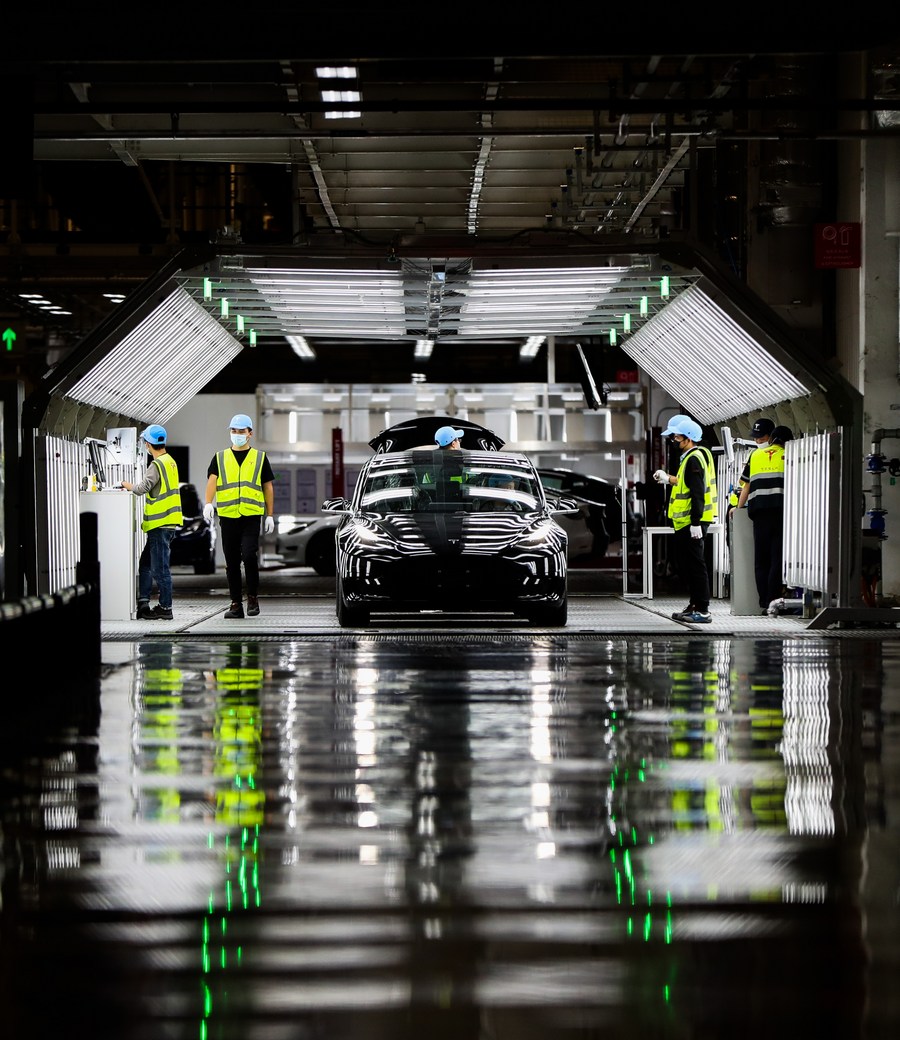
Employees work at the Tesla Gigafactory in Shanghai, east China, Nov. 20, 2020. (Xinhua/Ding Ting) Regional
pilot projects are also playing an important role in achieving China's
goals of carbon emission peak and carbon neutrality. A zero-carbon
technology industrial park was inaugurated in Wuxi last week, aiming to
introduce 1,000 relevant tech firms by 2025. All
members of the Yangtze River Delta will maintain multi-level and
regular interactions to provide greater support for the national
development and build a world-class city cluster, said Lou Qinjian,
Party chief of Jiangsu.
|



 Related News